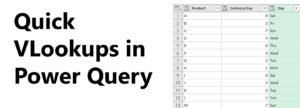
VLOOKUPs in Power Query are joins between 2 tables. If you’ve been using Power Query for a while, I’m pretty sure that you know about that. You can although apply INDEX MATCH styled lookups too, which I think is a quick way of applying VLOOKUP in Power Query. When I say quick – I just mean the ease of application but frankly I haven’t stress tested them on any large data and I don’t recommend anything other than good old styed RELATIONSHIPS in Power BI With all that said, let’s go check out VLOOKUP in Power Query. VLOOKUP in Power Query Example 1 – Consider this Data! I want to display the Day Name corresponding to the day number as a new column. Conventionally, I can apply a Left Outer Join in Power Query by applying a merge or solve this by writing a long IF statement, instead let’s explore a quicker way of doing this. I need two things- The day names as a list – {“Mon”, “Tue”.. and so on} A technique to match the Day Number to the order of the Day Name List. Let’s create a new custom column with the following M Code The curly brackets are the day list { [Delivery Day] – 1 } tell me which item to pick from the above list. Committing to this formula will display the desired output. Example 2 – A slightly more complex Case I have a Leave and Employee table. I want to find the leave count for the employees from the Leave table corresponding to Emp ID in Emp table. Let’s create a new Custom Column as Leave Count (in the Emp Table) Referencing the entire table (=Leaves) returns the full table in each row. Now let’s edit the same custom column to find the position number in Emp ID in the leave count list I can revise my formula as follows If you take a look at the last row of the above formula, I still have the 2 core parts ListName { PositionNo } The only difference is that now both the List Name (leavelist) and PostionNo (Positionno) are derived in the previous steps. Once I commit to the above code, I get the Leave Count. More on Power Query Dynamic Filter by a Range of Values in Power Query Dynamic Unpivoting in Power Query Nested LET Statement in Power Query Dynamic Data Types in Power Query Learn Power Query From Scratch!. Automate repetitive data cleaning tasks using Power Query A comprehensive course to learn Power Query to automate all your mundane and repetitive data cleaning tasks in Excel or in Power BI DOWNLOAD THE COURSE OUTLINE | ENROLL IN THE COURSE